A guided review of one real case through the eight KUIAVETS steps, from clarifying the outcome to deciding what should be sustained and scaled.

Choose one situation in which work, a decision, or a change has stalled. Eight connected questions will take you from the intended outcome to a safe first experiment and the evidence needed to judge it.
Answer for one specific case and use facts rather than a general impression. Each question builds on the previous answer, so complete the steps in order.
STEP 1
Please specify your role and select the system you want to analyze to narrow down the results.
CONCLUSION
The diagnostic has been successfully completed. Enter your name and email address so we can instantly generate a visualization of your system's profile and give you access to personalized recommendations.
SYSTEM PROFILE
This visualization shows exactly where your system is losing energy. Review the critical areas below and discuss the results with an expert to develop a plan for targeted changes.
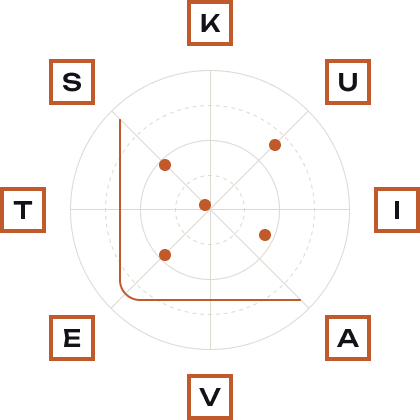
The analysis revealed the lowest scores in the Infrastructure and Adaptive Capacity areas, indicating significant gaps between work phases and a difficulty in responding to change. Although the basic processes are in place, complex interdependencies continue to consume too many of the team’s resources, and new experiments often fail to take root or merely add an additional burden on top of existing tasks. To prevent the organization from stalling, the first step is to synchronize feedback loops and eliminate manual coordination at the interfaces between departments, transforming fragmented actions into a single, coherent workflow.
